


WindEurope’s End-of-Life Issues & Strategies (EoLIS) seminar took place in the Netherlands on 22-23 November. The event attracted more than 300 participants to the Rotterdam Ahoy Convention Centre to share the latest thinking on how to manage wind farms reaching the end of their operational life.
Repowering is a major opportunity for Europe
Onshore wind farms normally last at least 20-25 years. There are various options available when a wind farm reaches the end of its life. Its lifetime can be extended by doing repairs and minor upgrades on the turbines. It can be completely decommissed by taking down the old turbines and restoring the site to its previous state. Or it can be repowered by replacing the old turbines with new, more efficient ones.
According to a WindEurope’s press release issued on the first day of EoLIS 2023, repowering can play a key role as Europe needs to double its wind energy capacity by 2030.
Repowering has many benefits, WindEurope reports. It nearly triples the electricity output of a wind farm while reducing the number of turbines by a quarter, all on the same site. Older wind farms are usually on the best locations but have the least efficient wind turbines and it makes sense to give them more powerful turbines.
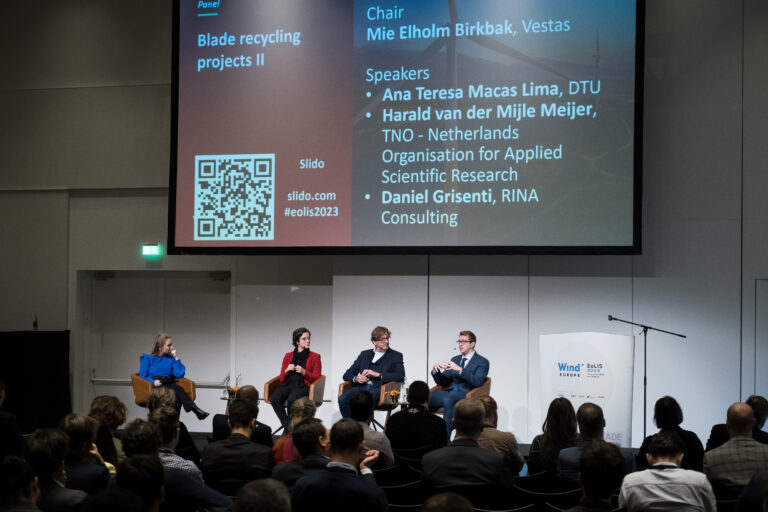
The Blade Recycling Projects session. (Image © WindEurope.)
Europe needs to double its wind energy capacity by 2030 to meet its climate and energy security goals. Repowering should play a big role in that, WindEurope says, but various constraints mean it’s not always feasible. According to new WindEurope data more than 13 GW of existing wind capacity will be decommissioned between now and 2030, but only 9 GW of repowered capacity will be installed. The association says governments need to incentivise repowering by simplifying the rules for it and speeding up permitting. New EU laws say repowering projects should get their permits decided in 6 months.
EoLIS 2023 also focussed on the sustainability and circularity aspects of wind energy. While 85-90% of a wind turbine is already recyclable, the blades are more challenging because of the composite materials they are made of. In 2021 the wind industry called for a Europe-wide ban on landfilling wind turbine blades and committed to re-use, recycle or recover 100% of decommissioned blades. Wind turbine manufacturers have set targets for fully recyclable blades and developed blade recycling solutions.
Blade waste can also be sent for cement co-processing, a solution that combines energy recovery and material recycling to produce greener cement. The cement industry and the producers and consumers of composite materials have called for the EU to scale-up cement co-processing (read the joint position paper). Old blades can also be repurposed for applications such as urban furniture.
Blade recycling
The Blade Recycling Projects II session on the second day of EoLIS 2023 introduced three new EU-funded projects, which pitched their objectives and the envisaged road to commercialisation.
REFRESH project coordinator Daniel Grisenti from RINA discussed the REFRESH smart, circular system for recycling composite materials from wind turbine blades (see the presentation). Ana Teresa Macas Lima, Senior Researcher at DTU (Technical University of Denmark) introduced the Blades2Build project, and Harald van der Mijle Meijer, Senior Consultant Wind Energy at TNO, presented the EoLO-HUBS project.
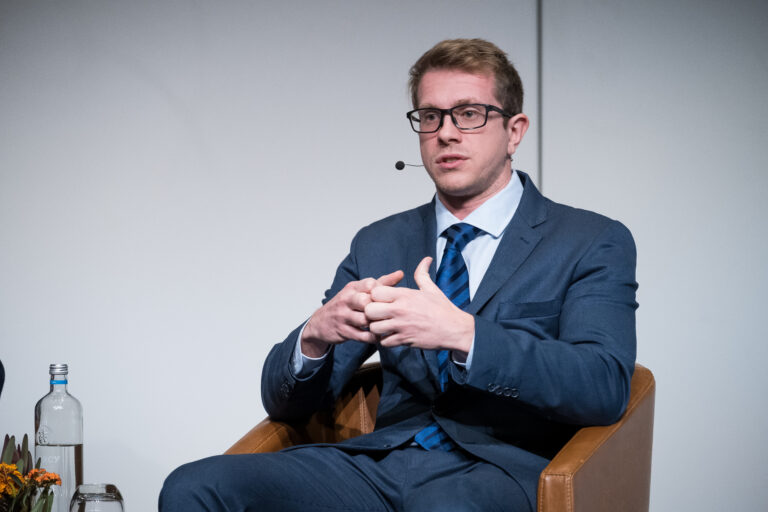
Daniel Grisenti, REFRESH project coordinator. (Image © WindEurope.)
The session was chaired by Mie Elholm Birkbak, Specialist, Innovation and Concepts, at Vestas.
REFRESH – turning waste into resource
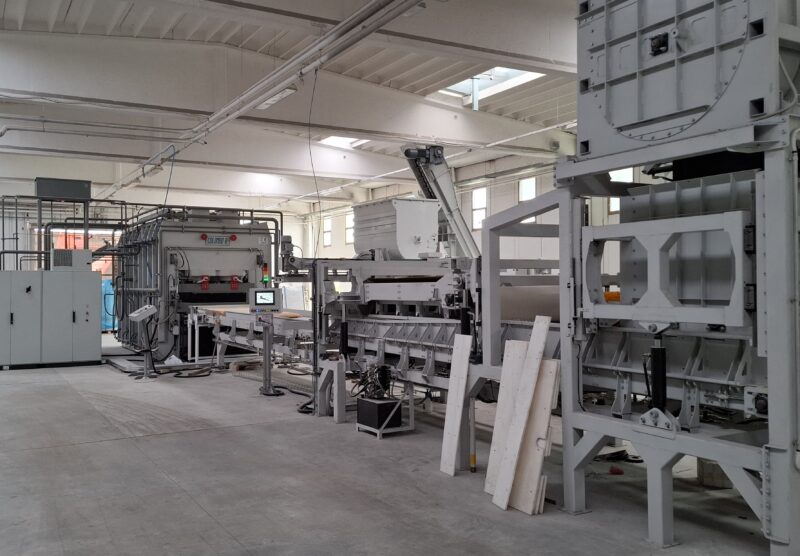
As the wind energy industry gears up for substantial growth, REFRESH (Smart dismantling, sorting and REcycling of glass Fibre REinforced composite from wind power Sector through Holistic approach) is answering the need for a sustainable solution for the management of large volumes of blades which will come from the decommissioning of older turbines. The project is developing a novel circular, smart system to enable improved recycling of glass fibre reinforced composites derived from turbine dismantling or reblading.
New technologies being developed during the project are aiming to maximise the volume and quality of the materials recovered. REFRESH is seeking to reintroduce secondary raw materials into the value chains of the energy sector as well as other markets.
EoLIS 2023 images © WindEurope.
Follow on social media #REFRESHprojectEU
REFRESH participates in WindEnergy Hamburg as member of Wind Innovation Cluster Hub
REFRESH at WindEnergy Hamburg 2026