


Project
The REFRESH concept
REFRESH (Smart dismantling, sorting and REcycling of glass Fibre REinforced composite from wind power Sector through Holistic approach) is a European project aiming to develop and demonstrate a novel circular, smart system enabling improved recycling of glass fibre reinforced composites derived from wind turbine dismantling or reblading.
The REFRESH project has received funding from the European Union’s Horizon Europe research and innovation programme under grant agreement no. 101096858.
The REFRESH concept for building a circular and self-sustainable value chain is based around three steps.

Highlights
- Design of portable dismantling, shredding & sorting technologies
- Development & customisation of recycling processes
- A new circular business model
- A novel digital blockchain traceability platform covering the whole supply chain
1. When a wind blade is decommissioned, information about the blade is collected (e.g. the materials, dimensions etc.) and the optimal recycling process selected. This will be achieved by using a dedicated blockchain traceability platform for collecting, protecting and sharing information, and an embedded decision-making software for selecting the most sustainable and efficient approach to recycling at that time. This decision depends on the technical parameters of the blade but also on factors such as logistics and the current market demand for the end products of the recycling process. Once the decision is taken, the blades proceed to the most suitable process.
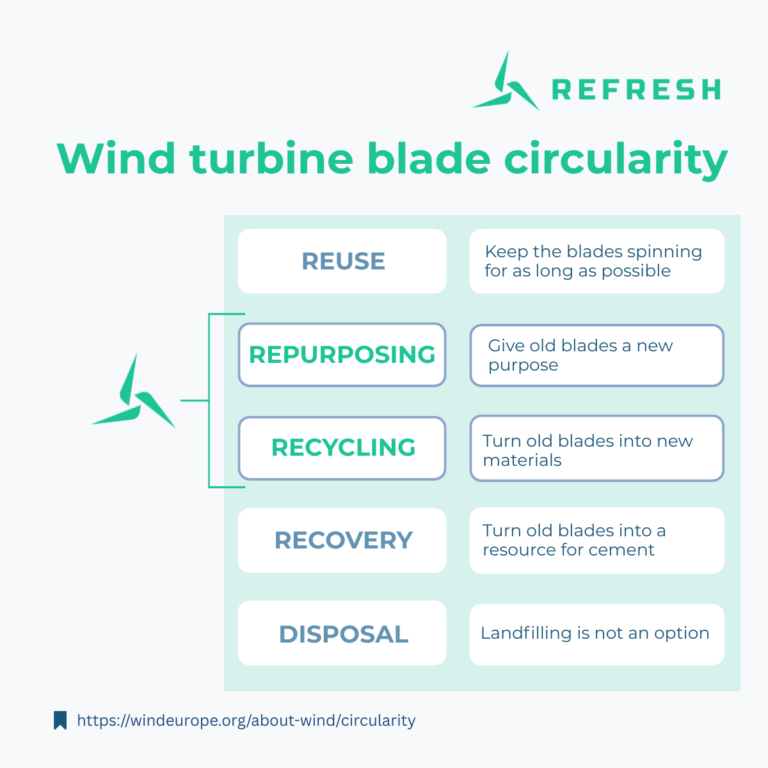
2. There are currently several solutions for decommissioned wind turbine blades. REFRESH will centre on the mechanical and thermo-chemical treatment of waste but will also explore re-use and repurposing options. GEES Recycling in Aviano, Italy, will design and upscale a new line based on its mechanical recycling process, where composites are ground into particles of various sizes and used as raw material to create multifunctional panels for applications in construction and other markets. Gjenkraft AS in Høyanger, Norway, will further develop and upscale its advanced thermal recycling process, which allows the recovery of long fibres. The project will also explore CIRCE’s experimental microwave-assisted pyrolysis and solvolysis processes to recover fibres, value-added chemicals and resin monomers. Repurposing strategies – using the whole blade or parts of it in new applications such as urban furniture – will also be developed.
The dust and fine particles generated during these processes will also be addressed. Rather than treating this as waste for disposal, Enecolab will optimise its thermochemical process to convert these low value materials into syngas usable as an energy carrier, and inert solids.
3. REFRESH will design a range of new products resulting from the outputs of the different recycling processes and will investigate their environmental impacts:
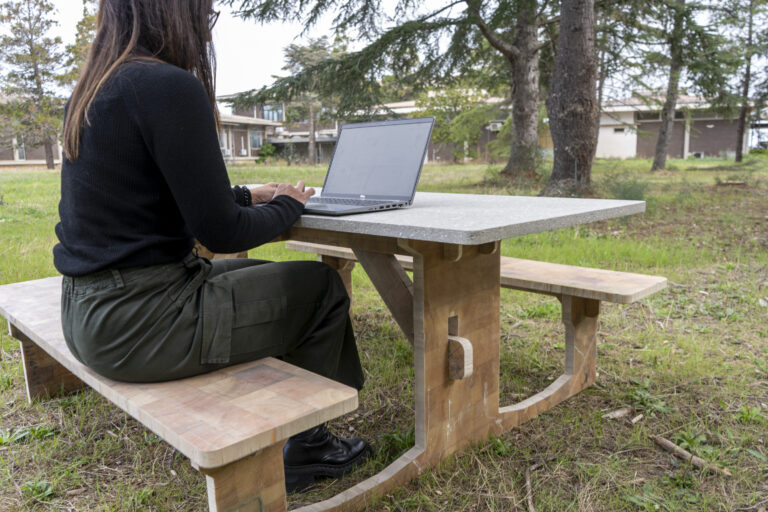
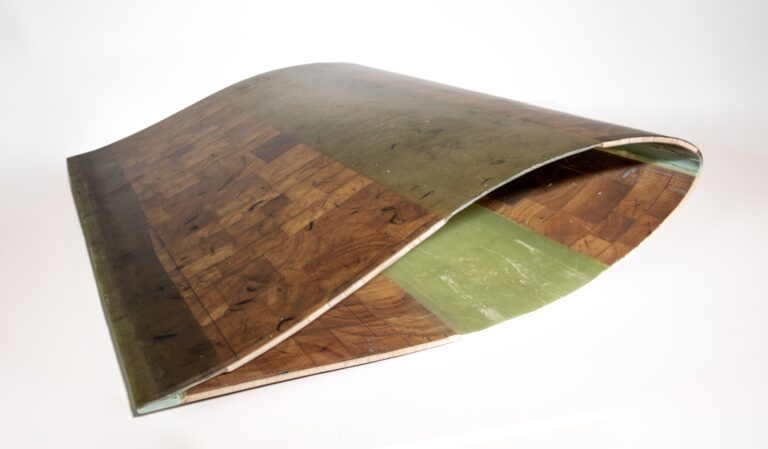
- Repurposing of blade parts: ETAT9 will provide cut blade parts for repurposing. REFRESH is exploring both the traditional approach and an alternative approach. A picnic table combines blade sections with panels manufactured using the GEES mechanical recycling process. A crash cushion is also being designed.
- Applications for the secondary raw materials from mechanical recycling: Potential applications for the secondary raw materials coming from mechanical recycling include formwork for concrete and prefab shelters.

- Applications for the secondary raw materials from thermal recycling: A nonwoven mat made from recycled glass fibres has been used in the outer skin of a section of a new wind turbine blade – the REFRESH circular blade demonstrates a closed loop solution in wind energy.
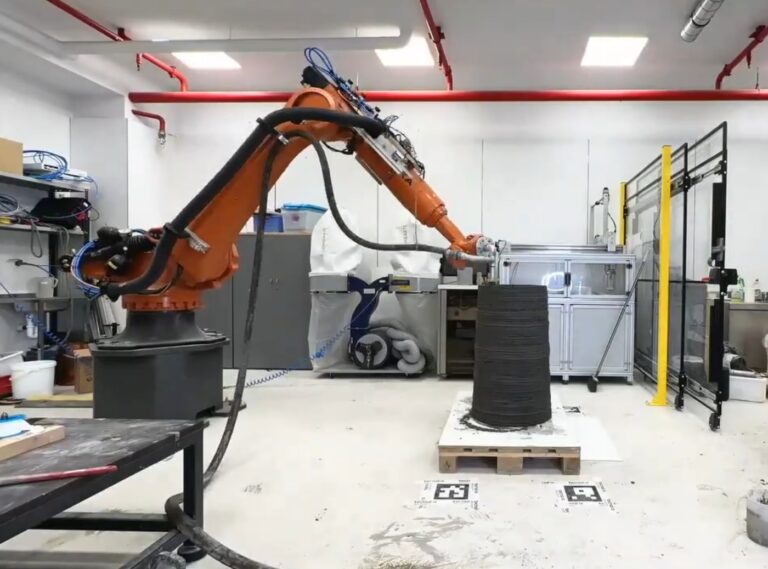
- Applications in concrete structures: Recycled glass fibres will be incorporated as reinforcement in cement formulations for 3D printing. A small-scale wind turbine tower will be designed, printed, and tested.
In addition, ACCIONA Construction will develop three industrial prototypes for the construction sector. The goal is to prove that we can replace virgin materials with recycled alternatives without sacrificing structural integrity.
Download the REFRESH value chain flyer.
The approach developed within the project will be validated by means of LCA and LCC analyses. The preliminary LCA results highlight significant environmental benefits for the REFRESH mechanical recycling and thermal recycling processes compared to traditional disposal methods.
Methodology
REFRESH will mainly focus on technology solutions development, prototyping and demonstration activities aiming to overcome the current technological gaps/uncertainties found at the end-of-life (EoL) stage for wind blades. The project will be clustered into two phases.
PROJECT WORK PACKAGES

WP1 Leader: MTB, WP2 Leader: GEES, WP3 Leader: RINA, WP4 Leader: GEES, WP5 Leader: TECNALIA,
WP6 Leader: CETMA, WP7 Leader: EuCIA, WP8 Leader: RINA
Design for upscale – technology solutions development
The first two work packages will develop the technical solutions to enable higher levels of recovery of raw materials from wind blades and their incorporation into applications suitable for marketing: new advanced dismantling and sorting technologies (WP1); and new recycling technologies (WP2) and production processes for secondary raw materials (WP5).
Market uptake strategies will be covered in WP3 to finalise a full package of technical and economic information as preparatory activity for the GO/NO-GO decision.
Deployment of REFRESH technologies
Following the GO/NO-GO decision at the end of Phase 1, the processes developed in previous WPs will be implemented in WP4 and an advanced smart tool for traceability will also be developed. At the moment there is no supply chain for the secondary glass fibre; current EoL business models of wind blades are linear (or downcycled for low grade applications). The project will allow an upgraded recovery of secondary raw materials and products along the life cycle of the selected value chains, enabling circularity from a technical point of view but also increased confidence in the material quality thanks to the traceability system.
The holistic approach developed within the project will be validated by means of LCA, LCC and health & safety analyses performed within WP6.
Replication and market uptake
Dissemination and communication activities, including clustering with other projects, networking and stakeholder engagement, will be tackled in WP7. This activity will aim to build the basis for a European network of recycling centres that could implement the technologies and contribute to solving logistics barriers.
REFRESH solutions
There are many projects with a circular economy approach for composites, but few have addressed the circular economy of glass fibre reinforced composites granting a high-grade final application. REFRESH is also the first in its field to develop and demonstrate integrated circular economy business models across glass fibre reinforced composites that integrate blockchain-based traceability, eco-design and product customisation, and that encompass the entire value and supply chains as well as engaging and supporting end-users throughout the process.
Solutions that will be developed within the REFRESH project
Advanced technologies
Dismantling & cutting of wind blades (ETAT9)
Specifications for an adaptive hydraulic saw to cut all kinds of wind turbine blades.
Shredding & sorting of the materials (MTB)
Development of a transportable shredder with an air-treatment integrated system to shred the blades on the dismantling site and capture the shredding fines.
Development of a specific sorting unit to separate the materials of a wind blade turbine.
Mechanical recycling (GEES)
To produce high-quality components with 80-95% of recycled materials.
To mass produce recycled composite panels in quantity and quality competitive with virgin products like MDF and plywood.
Microwave-powered thermal & solvothermal recycling (CIRCE)
Energy-efficient glass fibres, value-added chemicals and resin monomers recovery, while preserving up to 90% of the mechanical properties of the virgin fibres.
Gas-steam mixture treatment at direct pyrolysis process (Gjenkraft)
Under the pyrolysis recycling of composite mixtures, the purification of the long fibres will be more efficient with direct implementation of the purification step during the pyrolysis treatment.
Circularity designed materials & end-products

Tecnalia’s 3D printing facilities.
Novel mechanically recycled end products (GEES)
Optimised end products with high percentage (80-95%) of secondary raw materials.
Novel composites & related products (CETMA)
Optimising the processability of recycled products to fulfil circular economy needs & realising robust processes for the production of a new generation of composites.
3D printed cement-based products (TECNALIA)
Optimising the process for additive manufacturing of cement products with secondary glass fibres.