

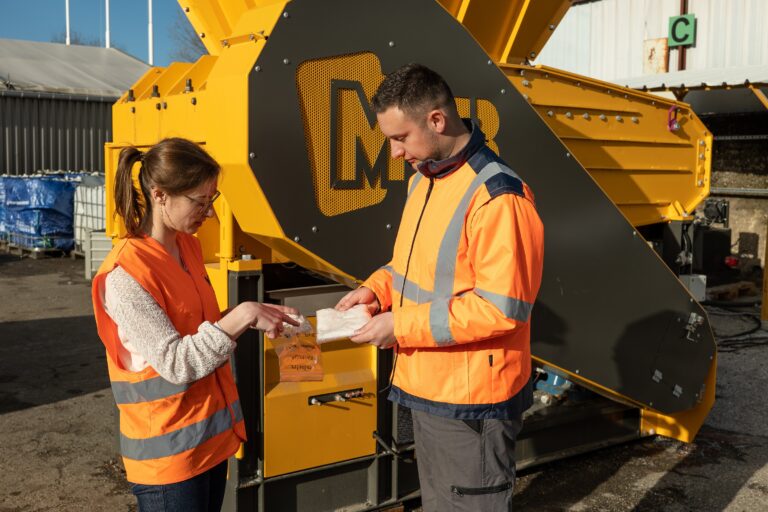
MTB’s R&D teams study the shredding and sorting of complex waste streams. (Image © MTB.)
French company MTB is a leader in industrial waste management, as a recycler of complex industrial waste and as a manufacturer of recycling equipment. In the REFRESH project MTB will apply its expertise in shredding and separating technologies to treating wind turbine blades.
MTB (Machines de Triage et de Broyage) was established in 1981, when the company’s founder developed mechanical methods for recycling non-ferrous metals from cables. As the first machines were being built for sale, he decided to develop recycling lines for aluminium and copper cables to test and improve the equipment.
Today, MTB has grown to be a leader in industrial waste management, both as a recycler of complex industrial waste and as a manufacturer of recycling equipment. The MTB model is unique in the world. Its goal is to provide high added value and low environmental impact solutions, technologies and services for the treatment of complex waste products, in particular those containing metals. The group is specialised in waste pre-treatment technologies (such as shredding and mechanical separation), but it relies on a large network of partners to reach players across the entire value chain.
MTB Manufacturing designs, manufactures, integrates and sells industrial equipment, solutions and lines to recycle various waste products. From copper and aluminium electrical cables to tyres, aluminium scrap, ordinary industrial waste (OIW), motors, waste from electric and electronic equipment (WEEE) and electric vehicle batteries, its mission is to develop waste treatment solutions for today and for the future. MTB Recycling operates a 7-line recycling plant. Thanks to its industrial- scale Test Centre and R&D teams, MTB studies the shredding and sorting of complex waste streams in order to develop new recycling processes for customers. By combining the skills of all its affiliates, MTB also supports manufacturers in their eco-design strategies to improve the recyclability of their future products.

MTB designs and builds shredding equipment to enable efficient size reduction of waste materials. (Image © MTB.)
MTB’s role in REFRESH
MTB is leading Work Package 1: Design of portable dismantling, shredding and sorting technologies, collaborating with partners STD, GEES Recycling, Enecolab, Acciona, Tecnalia and RINA.
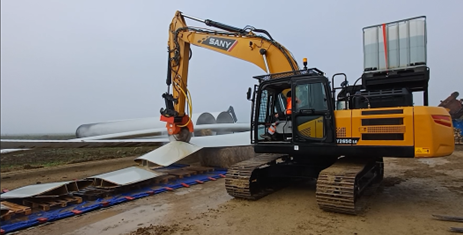
This Work Package, which runs from January 2023 to June 2024, will develop solutions to enable higher levels of recovery of high-purity materials from wind turbine blades. While STD will develop equipment to cut the end-of-use turbine blades, MTB will design a machine to shred the cut pieces of blade into smaller particles suitable for sorting, and a unit to efficiently and accurately separate the blade materials so that they are suitable for further treatment in the various recycling processes the project is developing. MTB will design a shredder specifically adapted to the treatment of composite materials and designs will be tested at a prototype scale at the MTB Test Centre. MTB will perform sorting tests on the shredded blades to separate the blade materials. The sorting tests will be performed on mechanical sorting machines, but, if necessary, other technologies are available within MTB’s network of partners. Concepts for transportable shredding and sorting machines, which can be used at the turbine dismantling site, will also be considered.
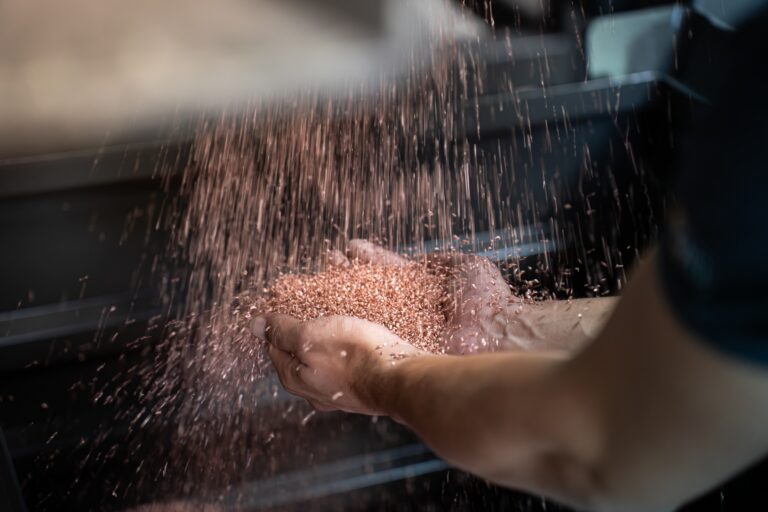
Granulators process shredded material into homogenous granulates to optimise separation and sorting operations. (Image © MTB.)
We spoke to Esthel OSSÓ, eco-design engineer, about MTB’s activities in REFRESH.
Why did MTB decide to join the REFRESH project? What was MTB’s experience of processing composite materials before REFRESH?
The purpose of MTB’s Test Center is to develop solutions to recycle complex waste streams. The eco-innovation team of MTB was increasingly solicited to find solutions to recycle wind blades. The REFERSH proposal was the perfect opportunity to jump into this challenging topic!
What are the main challenges in shredding wind turbine blades compared with other materials?
The challenges in shredding wind turbine blades are multiple. First, the exceptional size of the product: the length of a wind blade can go from 10 m to 100 m. The logistics that needs to be deployed around these waste streams is unusual. Then, wind blades are designed to resist harsh environment conditions, for a long time period (20 to 25 years). Composite materials are a good answer to this requirement, that is why their end-of-life treatment is challenging: difficult to cut, material wear, dust and fibres management …
What are the main challenges in separating the blade materials compared to other materials?
Depending on their design, the materials used to manufacture wind blades vary greatly (glass fibre, carbon fibre, foam or balsa core material, adhesives, etc.). The sorting of composite and plastic mixes requires the combination of multiple technologies in order to obtain usable outputs (purity, yield).
What innovations will be required in shredding and sorting technologies for composites?
MTB will develop a shredder specifically for wind turbine blades, which will trap the dust and fines emitted during shredding, and develop a tailor-made sorting unit with an integrated air filtration system. Dust and fines emitted these processes will be further processed into new uses. A transportable shredder could be developed. MTB has already developed the BOX range of ‘plug and run’ turnkey recycling lines in a container for cables, tyres, plastics and other materials.
From MTB’s experience of working with other materials and industries, what best practice or expertise could be transferred to wind blade recycling?
Thanks to its 40 years’ experience in recycling, MTB relies on an extensive network of industrial and academic partners to combine different expertise and find the best solutions to build up entire recycling channels: from the technical pre-study to the implementation of a complete value chain.
Meet our other partners:
Improved dismantling, shredding and sorting technologies