

 At the WindEurope Annual Event 2025 in Copenhagen, REFRESH partner ETAT9 presented a poster discussing its sustainable approach to cutting wind turbine blades.
The poster, Cutting end of life wind turbine blade on-site in a sustainable approach before recycling or re-use, was presented by Magali Bazin, CTO at ETAT9.
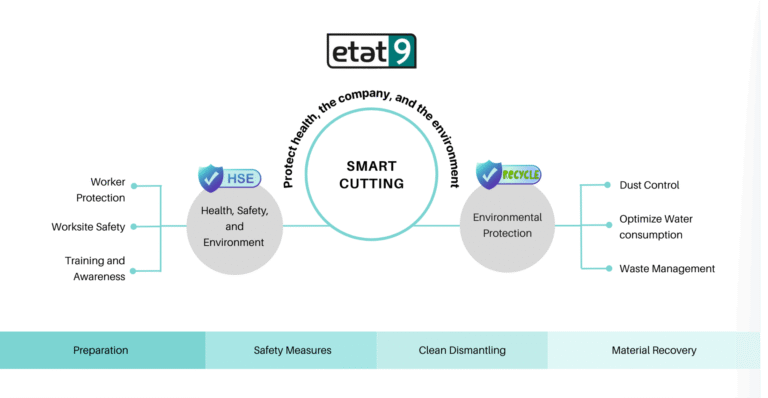
Smart cutting
ETAT9’s role in the REFRESH blade recycling project is to design an advanced dismantling system for blades and to prototype the dismantling solutions.
As part of the project, ETAT9 carried out a study at an onshore worksite on blades of up to 80 m in length. The study considered five criteria considered most important for cutting operations:
- impact on workers;
- impact on the environment;
- cutting precision;
- transportability and mobility of the technology on site;
- cost.
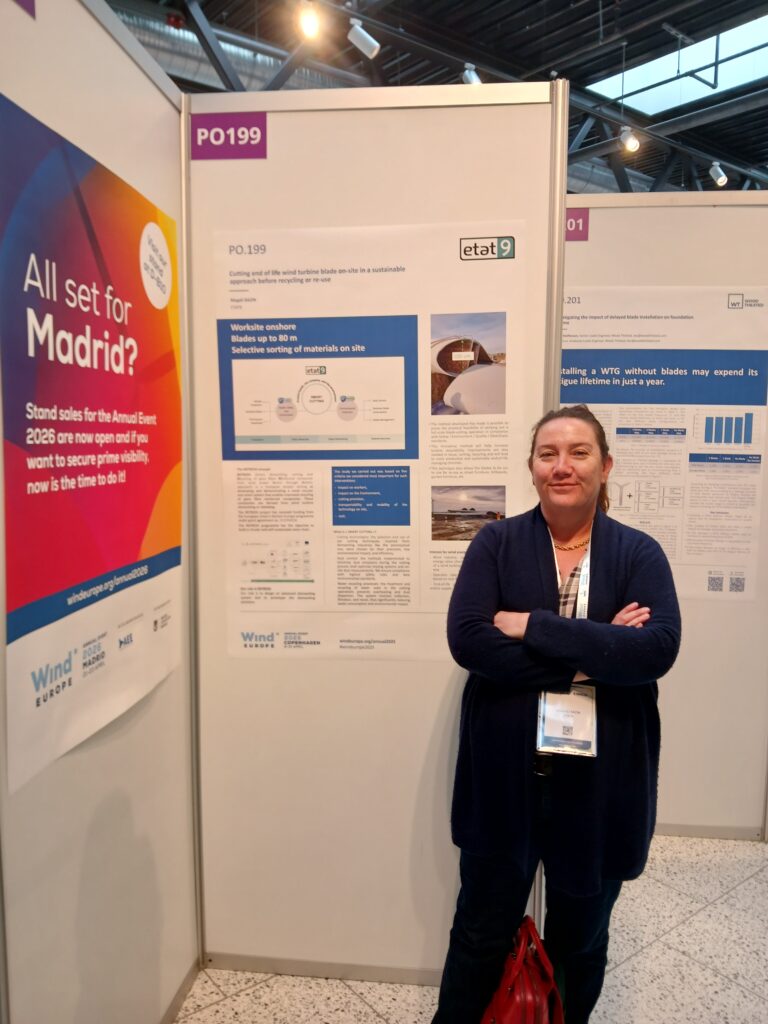
Magali Bazin discussed ETAT9’s blade cutting technologies at the WindEurope event in Copenhagen.
The smart cutting method developed has made it possible to prove the practical feasibility of carrying out a full-scale blade cutting operation in compliance with safety, environment, quality, and cleanliness standards.
It encompasses:
- Cutting technologies: the selection and use of ETAT9 cutting techniques, inspired by dismantling operatons in industries like aeronautics, and chosen for their precision, low environmental impact, and efficiency.
- Dust control: the methods implemented to minimise dust emissions during the cutting process optimise misting systems and on-site dust measurements. This ensures compliance with highest safety rules and best environmental standards.
- Water recycling processes: the treatment and recycling of water used in the cutting operations prevents overheating and dust dispersion. The system involves collection, filtration, and reuse, thus significantly reducing water consumption and environmental impact.
This innovative method will help increase turbine recyclability. Improvements are also needed in reuse, sorting, and recycling. The REFRESH project is addressing all these areas with the aim of enabling more productive and sustainable channels for managing end-of-life blades.
This technique also allows the blades to be cut to size for re-use as street furniture, billboards, garden furniture, etc.
REFRESH participates in WindEnergy Hamburg as member of Wind Innovation Cluster Hub
REFRESH at WindEnergy Hamburg 2026