

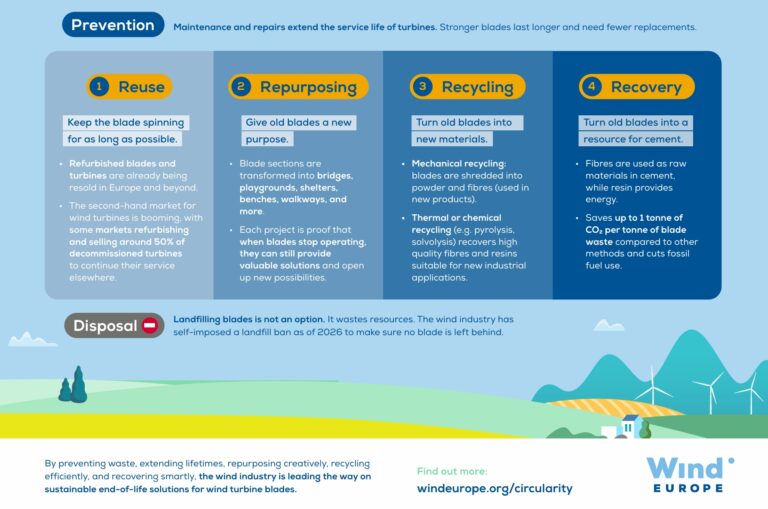
WindEurope has created an infographic illustrating the different paths blades can take at the end of their life.
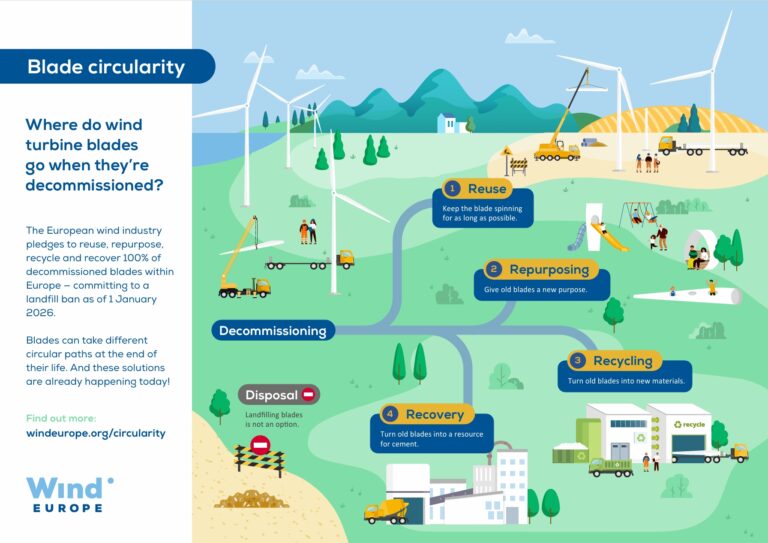
Reuse
Keep the blade spinning for as long as possible.
- Refurbished blades are already being resold in Europe and beyond.
- The second hand market for wind turbines is booming, with some markets refurbishing and selling around 50% of decommissioned turbines to continue their service elsewhere.
Repurposing
Give old blades a new purpose.
- Blade sections are transformed into bridges, playgrounds, shelters, benches, walkways, and more.
- Each project is proof that when blades stop operating they can still provide valuable solutions and open up new possibilities.
Recycling
Turn old blades into new materials.
- Mechanical recycling: blades are shredded and used in new products.
- Thermal or chemical recycling (e.g. pyrolysis, solvolysis) recovers high-quality fibres and resins suitable for industrial applications.
Recovery
Turn old blades into a resource for cement.
- Fibres are used raw materials in cement, while resin provides energy.
- Saves up to 1 tonne of CO2 per tonne of blade waste compared to other methods and cuts fossil fuel use.
 WindEurope has set up a new circularity hub to showcase the latest solutions, making the vision of circular wind energy a reality. European companies are investing in new facilities and championing creative and innovative solutions for decommissioned blades. The different examples illustrate sustainable second-life solutions that are already available today.
The REFRESH project
As an EU-funded project, managed by CINEA, REFRESH supports the sustainable growth of Europe’s wind industry by developing innovative strategies and technologies to advance blade circularity. Now entering its fourth year, REFRESH is scaling up sustainable repurposing and recycling solutions, covering the whole value chain from end-of-life blades to new products. LCA and LCC analyses and a novel blockchain traceability platform support the project’s approach.
View the REFRESH project value chain.
Circular Economy Act
The new Circular Economy Act will strengthen sustainable waste management practices. In this context, the European wind industry is calling for a new set of waste codes. Currently wind turbine waste is not labelled as such and often mixed with other forms of construction waste, making it harder to trace blade waste and treat it adequately.
To avoid this problem, the industry is calling for dedicated waste codes for decommissioned wind turbine blades.
WindEurope, EuCIA, Cefic UP/VE, Epoxy Europe, European Boating Industry (EBI), Glass Fibre Europe, and Cement Europe, have published a joint position paper on the upcoming Circular Economy Act. This highlights several regulatory solutions that could enable the deployment and commercialisation of sustainable waste treatment solutions for end-of-life composites.
Read the position paper: The Circular Economy Act and composites.
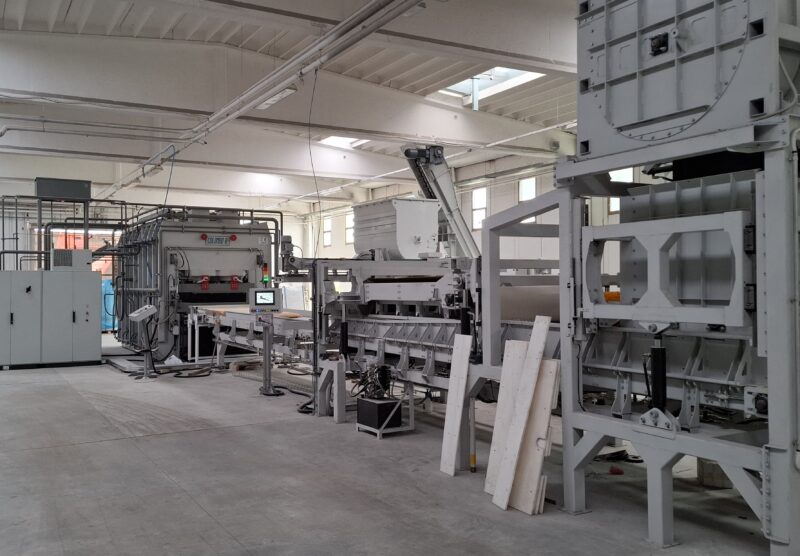
REFRESH participates in WindEnergy Hamburg as member of Wind Innovation Cluster Hub
REFRESH at WindEnergy Hamburg 2026