


Rubén Castaño Álvarez next to the 3D printed tower.
During our recent stakeholder workshop, Rubén Castano from TECNALIA discussed the use of recycled glass fibres obtained from decommissioned wind turbine blades as reinforcement in cement formulations for 3D printing.
This is one of the REFRESH demonstrators for showcasing end products with a high content of secondary raw materials. The cement formulations developed will be tested in the 3D printing of wind turbine tower sections.
3D printing objectives
In this work, TECNALIA’s four main objectives are to:
- develop a cement mix suitable for 3D printing, considering the process and application requirements;
- develop a 3D printing mix incorporating recycled fibres with the aim of improving the mechanical properties of the material;
- perform preliminary testing of the fibre-reinforced mixes, both in the green and the hardened states;
- print a scaled down version of a wind turbine tower to test and validate the material, the process. and design of the tower.
Materials for 3D printing have four main requirements:
- flowability to fill correctly the pumping system;
- extrudability for the material to go through the nozzle and form a filament;
- buildability to properly withstand the weight of the layers top; and
- hardened state strength to withstand the stresses during transport, installation and service.
TECNALIA has been testing both thermally recycled and mechanically recycled fibres, incorporating different fibre dosages ((2, 5 and 10%) in the cement formulations, and evaluating the properties both in the fresh and hardened state.
The tower test
A 3D printable scaled down version of a wind turbine tower was designed. Several limitations have to be considered in the design, printing, and testing, included: the height of the ceiling in the TECNALIA 3D printing laboratory (2.9 m), the nozzle size (round nozzle, 20 mm in diameter), a minimum of two filaments per layer to give a wall thickness of about 40 mm, and for the part testing ~150 kN on cyclic loads.
A significant milestone has been reached with the successful printing of a tower 2.2 m in height with a base diameter of 0.49 m and a top diameter of 0.38 m. The material used is a high-performance concrete mix with a low CO₂ footprint.
A video of the 2.2 m tower being printed is available on the REFRESH YouTube channel.
A second tower has also been designed, which is 2.7 m high and has a base diameter of 31 cm.
Work is ongoing to test additional designs and further optimise both the printing process and the material.
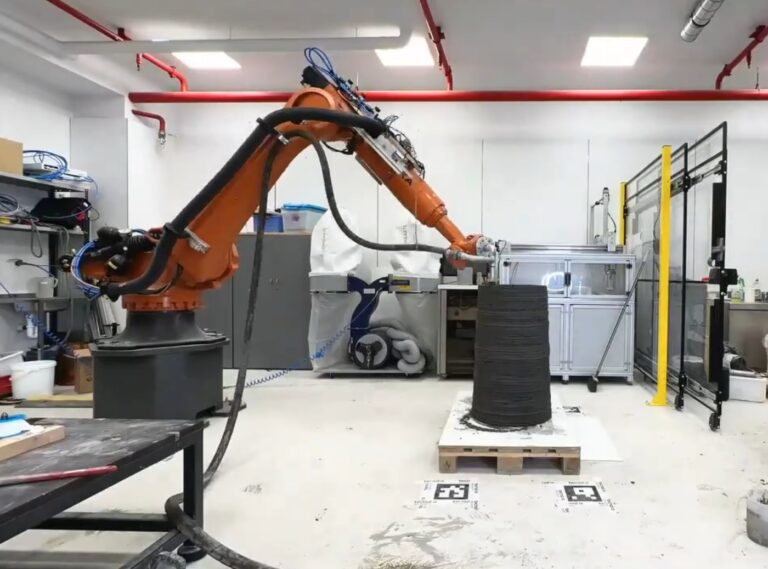
3D printing the 2.2 m tower took approximately 2.5 hours.
Further information
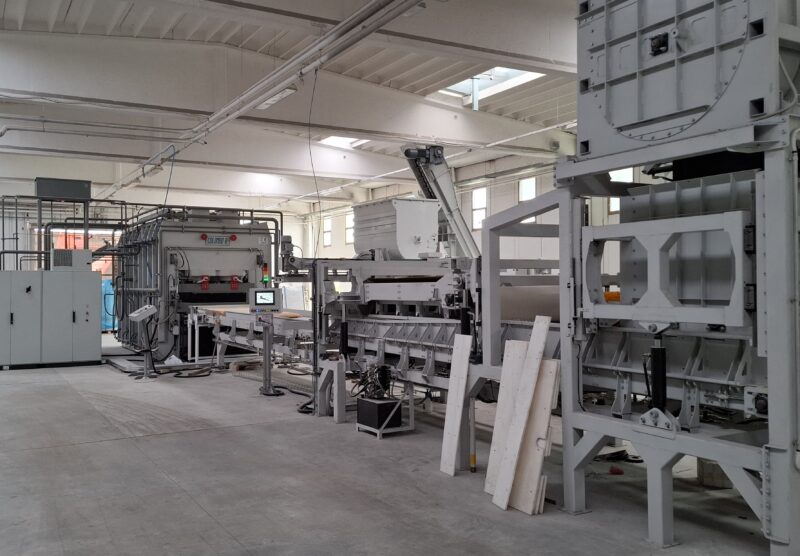
REFRESH participates in WindEnergy Hamburg as member of Wind Innovation Cluster Hub
REFRESH at WindEnergy Hamburg 2026