

In addition to optimising and upscaling recycling processes for wind turbine blades, the REFRESH solution includes the development of new products using the recycled materials. Products will be designed for applications in the wind sector and other markets. In order to minimise the environmental impact of these new products, an eco-design strategy will be followed.
Work Package 6: Circular by Design, led by CETMA, focuses on the design for circularity strategy, as well as life cycle assessment (LCA), which is the responsibility of RINA. The overall objective is to validate the holistic approach developed within the project for the end-of-life (EoL) management of wind turbine blades.
In July 2024 (M19), CETMA started work on Task 6.3: Manufacturing end-products using high amount of secondary raw materials. This task will run until the end of the project.
 The aim of this work is design products manufactured with the recycled materials from each of the recovery processes developed in the project.
In the previous Task 6.1: Eco-design strategy, which concluded in M18, potential applications were reviewed with the relevant partners. A number of products were selected based on market demand and confidence in reaching technical targets.
The concept design aimed to limit, as much as possible, the use of virgin feedstock by incorporating recycled materials.
Four case studies will be demonstrated at prototype level (TRL 6).
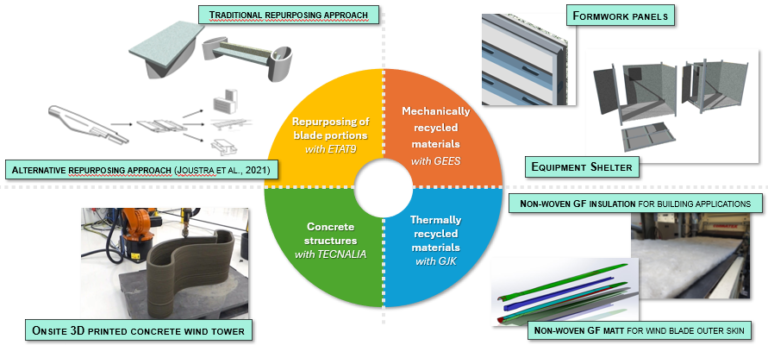
Repurposing of blade portions
ETAT9 will provide cut blade parts for repurposing.
With regards to the repurposing strategy, i.e. re-using an existing part of the blade for a different application after only minimum re-working, REFRESH is exploring both the traditional approach and an alternative approach.
The traditional approach is to repurpose large structural parts. A possible application is to develop tables or benches made from blade sections and panels manufactured using the GEES mechanical recycling process.
On the other hand, segmentation of the blade into construction elements like beams and panels with standard size and curvature is the alternative approach (J. Joustra et al. 2021, Delft University of Technology). Prefabricated building could be a promising sector for use of such blade segments.
Applications for the secondary raw materials from mechanical recycling
Regarding potential applications for the secondary raw materials coming from mechanical recycling, framed formworks and prefab shelters are the main options being considered for the discussed with GEES Recycling.
The idea is to use recycled materials in place of traditionally used ones in both sheet panels and load-bearing structures.
Applications for the secondary raw materials from thermal recycling
CETMA is collaborating with Gjenkraft to develop a nonwoven product based on recycled (pyrolised) glass fibres recovered using the Gjenkraft thermal recycling process.
Two applications will be explored:
- a nonwoven mat to be used as outer skin for new wind turbine blades; and
- a thermal-acoustic insulation for use in the building sector.
Applications in concrete structures (3D printed wind turbine tower)
Applications of recycled materials in concrete structures are being explored with TECNALIA.
This work will consider on the onsite 3D printing of a wind turbine tower. TECNALIA will develop a scaled (1/25) prototype using cement-based materials reinforced with recycled fibres.
Printing materials are currently under development in Work Package 5: Digital platform and prototype development, led by TECNALIA.
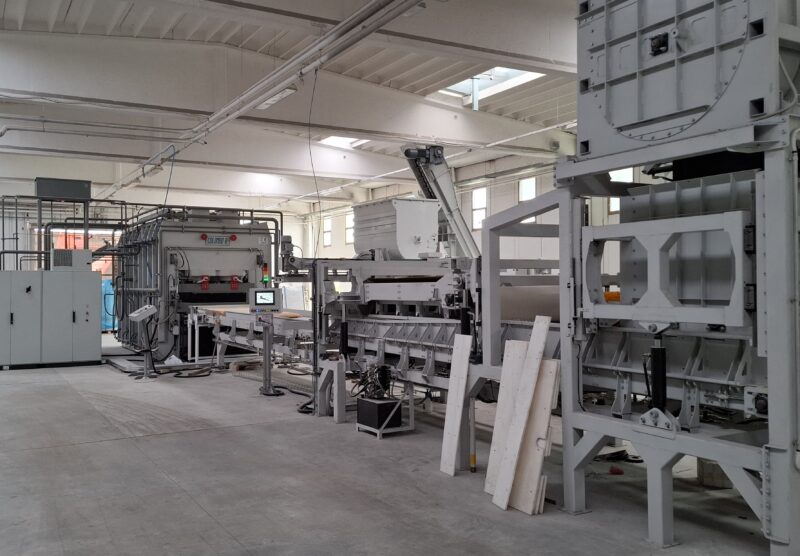
REFRESH participates in WindEnergy Hamburg as member of Wind Innovation Cluster Hub
REFRESH at WindEnergy Hamburg 2026