

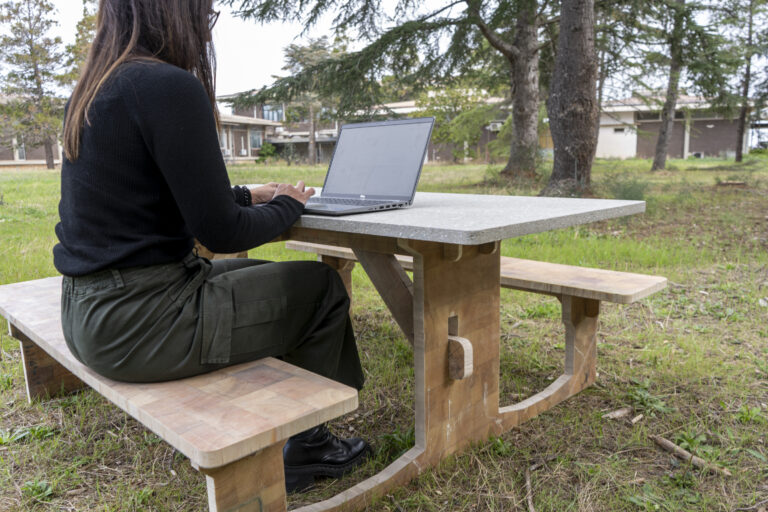
The CETMA picnic table. The top is a panel manufactured by Gees Recycling.
The REFRESH project explores both recycling and repurposing strategies for end-of-life (EoL) wind turbine blades.
With regards to the repurposing strategy, i.e. re-using an existing part of the blade for a different application after only minimum re-working, REFRESH aims to explore both the traditional approach and an alternative approach.
The traditional approach is to repurpose full blade sections as they are. There are already examples of wind turbine blades being transformed into playgrounds, pedestrian bridges, benches, shelters, and other urban furniture installations.
On the other hand, the segmentation of the blade into construction elements like beams and panels with standard size and accuracy has recently been proposed as a novel repurposing approach and reported to allow diversifying the potential applications (Joustra et al., 2021). Prefab building could be a promising sector for reuse of these blade segments.
With regards to the alternative approach, the idea is to try applying a reverse engineering approach to an EoL wind blade during its dismantling session. This to collect all geometry and material data that are needed for designing the cutting stage of standardised elements looking at the final application. The REFRESH partners involved CETMA and ETAT9 agree that preliminary to any worksite activity – very difficult to manage discontinuously – real tests are needed based on a ready-to-use design to collect the actual constraints of the strategy.
The REFRESH picnic table
As an example, the picnic table formerly developed by Joustra et al. (2021) and a similar approach can be used.
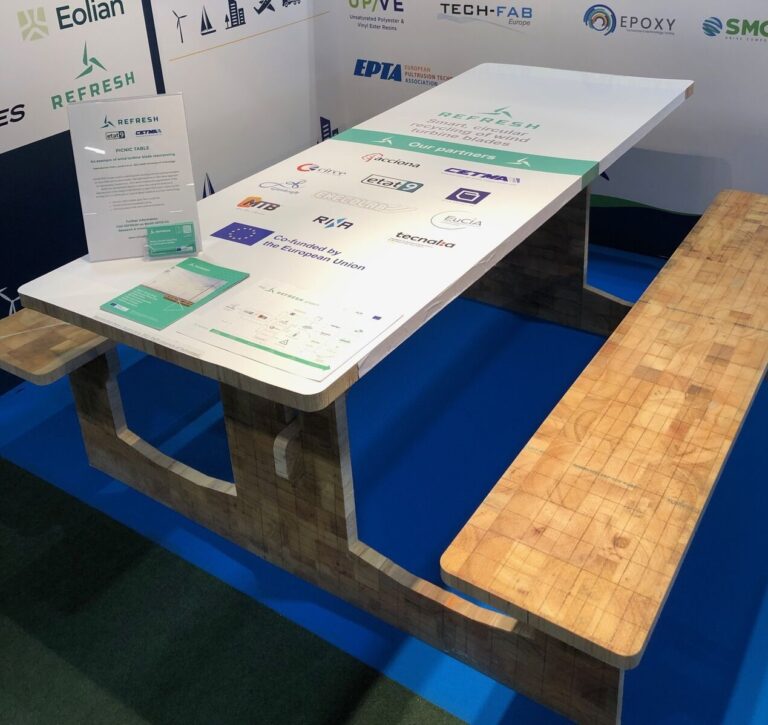
The ETAT9 picnic table was exhibited at JEC World 2025.
The original drawings were retrieved – they are public documents – so that ETAT9 was able to extract all the product parts by means of waterjet cutting of blade materials already available on stock (balsa/fibreglass composite sandwich planks as flat as possible).
Selected materials underwent an experimental mechanical characterisation (tensile and bending tests) at CETMA and the results were used to numerically validate their structural effectiveness for the intended application. Then, two preliminary prototypes were assembled at ETAT9 and CETMA using mechanical fasteners and compared to each other and also to the original author’s limits and opportunities of this joining method.
The ETAT9 prototype is ‘fully repurposed’ and it was exhibited at JEC World 2025 in Paris.
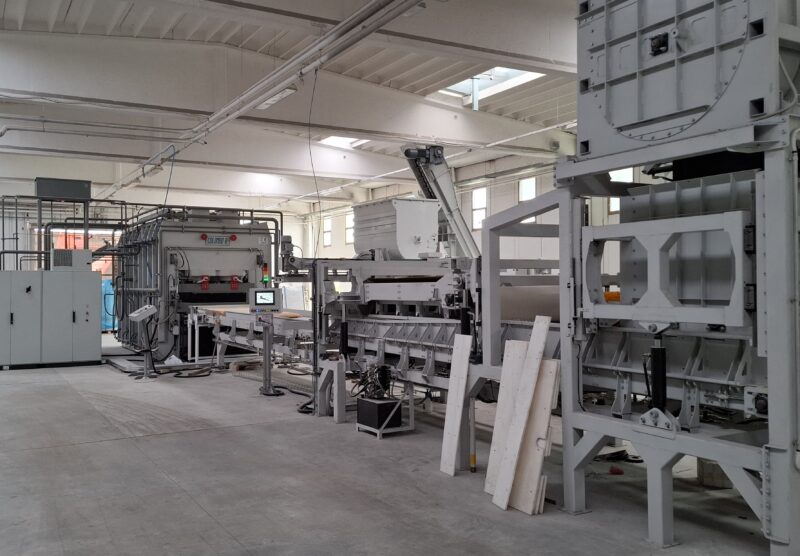
The CETMA prototype combines repurposed elements with the mechanical recycling procedure developed in REFRESH. A recycled panel was produced by Gees Recycling using EoL blade materials and added as the top of the picnic table.
Reproduction of this design is the REFRESH project’s first step in exploring this strategy prior to developing an original design based on a similar methodology.
Next steps
The team is now working on the development of an original REFRESH repurposed prototype. The idea is not to limit the project effort on items with ‘simply’ self-supporting features (tables, benches, shelters etc.) but to explore more structural applications that could take advantage of the residual mechanical performance of EoL composite components.
REFRESH participates in WindEnergy Hamburg as member of Wind Innovation Cluster Hub
REFRESH at WindEnergy Hamburg 2026