

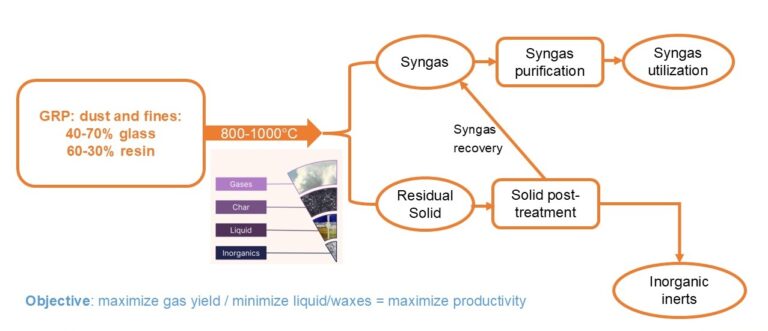
Enecolab GEOW process for recovery of dust and fines: high temperature pyrolysis to generate gas fraction as energy carrier.
Dust is an inevitable byproduct of industrial processes. In the management of end-of-life wind turbine blades, process steps such as cutting, shredding and recycling all result in generation of dust and fine particles. Rather than treating this as waste for disposal, REFRESH partner Enecolab is developing its thermochemical process to obtain value from this material.
Blade recycling processes can result in significant amounts of dust, perhaps accounting for up to 50 wt% of the initial material. Current routes for managing this include landfill and as fuel for cement factories. The REFRESH project’s objectives are to:
- reduce the amount of dust and fines generated;
- increase the amount captured;
- convert this material into a valuable resource (energy).
In Enecolab‘s GEOW® process, high temperature pyrolysis converts dust and fines (40-70% glass, 60-30% resin) to obtain syngas as an energy carrier as the primary product and inert inorganic solids as a secondary product. By focusing on a high temperature process it is possible to maximise the gas output and minimise liquid production. This boosts productivity, since liquids tend to have a higher degree of chemical complexity and gases are easier for the end user to utilise.
Pyrolysis is followed by a syngas purification stage. A post-treatment step for the residual solids results in clean inorganic inerts which can be used, for example, as a filler.
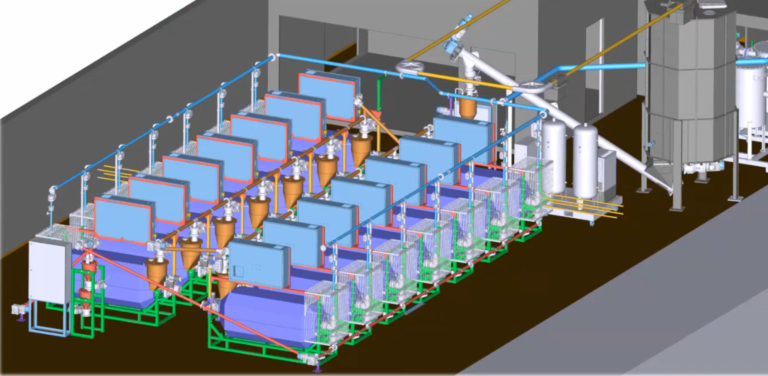
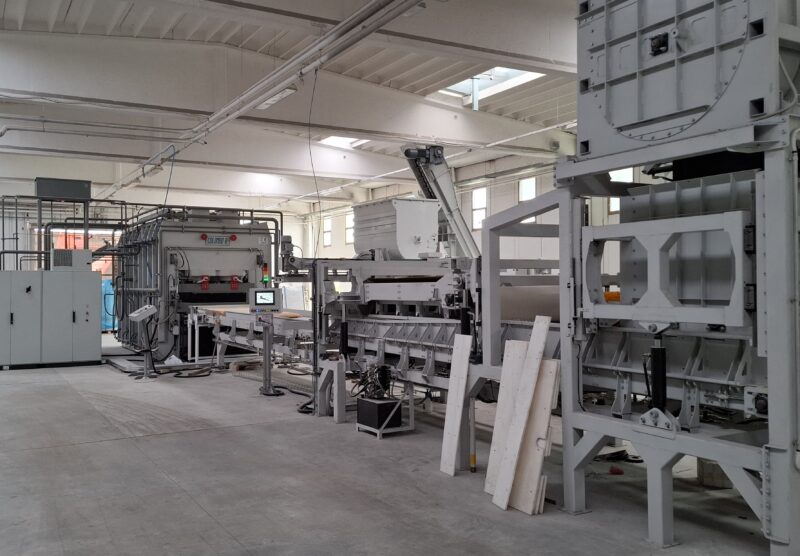
Mockup of a modular design with 14 reactors designed to process 2 kt/year of feedstock.
Enecolab continues to refine its industrial scale reactor to increase the feed rate. The concept is a modular system, where a number of reactors are linked together, tailored to the amount of feedstock available to process.
Industrial waste to energy system
Enecolob’s GEOW technology can effectively convert the dust and fines generated during blade recycling into syngas usable as an energy carrier, and inert solids.
The process is designed to be integrated into an industrial process to minimise and inertise the waste and recover the energy content.
Preliminary results clearly indicate that the amount of energy recovered in the GEOW process exceeds that used in the process.
From end-of-life blades to new products
Carlo Andreazza presented Enecolab’s latest results during the recent REFRESH stakeholder workshop From End-of-Life Blades to Circular Products.
Watch the presentation on YouTube.
Discover further Enecolab presentations on our Publications page.
REFRESH participates in WindEnergy Hamburg as member of Wind Innovation Cluster Hub
REFRESH at WindEnergy Hamburg 2026