

The wind energy industry is committed to promoting a more circular economy and avoiding waste. A sustainable process for dealing with wind turbines at the end of their service life is needed in order to maximise the environmental benefits of wind energy from a life cycle approach.
A wind turbine typically has a service life of 20-25 years or more. However older wind farms are now being repowered or decommissioned. While most components of a wind turbine, including the foundation and tower, have established recycling practices, the rotor blades currently present more of a challenge.
Glass fibre composites are the primary material used in the manufacture of wind turbine blades. Durable, high performance composite materials enable the design of longer, lighter blades with optimised aerodynamic shapes. Composite blades are capable of operating in harsh environments for many years. Composite materials cannot be easily separated into their fibre and matrix components, which is the basis for their success, but also means they are inherently difficult to recycle. Existing solutions for recycling glass fibre reinforced composites are not yet widely available or economically competitive. Building a new circular economy strategy for the growing number of end-of-use turbine blades is crucial.
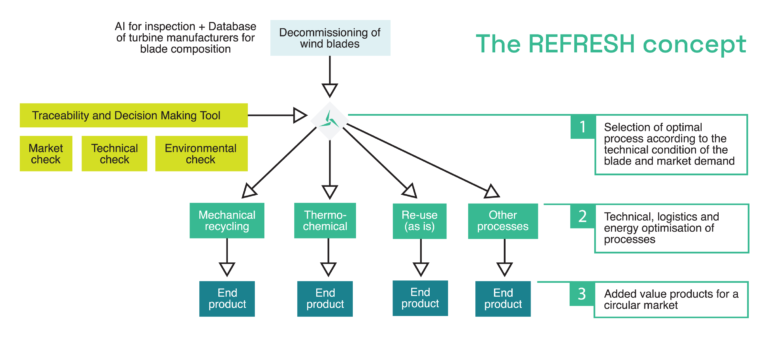
The REFRESH concept.
The REFRESH project is developing a circular, smart system for an improved recycling of glass fibre reinforced composites derived from wind turbine dismantling or reblading.
A circular value chain
The REFRESH concept for building a circular and self-sustainable value chain foresees three steps.
- When a wind blade is decommissioned, the optimal recycling process will be selected according to the technical condition of that blade and current market demand. This will be achieved by using a dedicated tracing tool for collecting, protecting and sharing information and an embedded decision-making software for selecting the most sustainable approach to recycling at that time.
- The project will focus on the mechanical and thermo-chemical treatment of waste but will also explore further processing and re-use options.
- A range of new products resulting from the outputs of the different processes will be designed.
The approach developed within the project will be validated by means of life cycle assessment (LCA) and life cycle costing (LCC) analyses.
New developments elaborated during the project will push technologies to maximise the volume (>90%) and quality (>95% purity) of the materials recovered.
The REFRESH concept has significant potential for replication in other large and high-value markets where the use of composite materials is increasing, including the aerospace, automotive, and marine sectors.
REFRESH is funded under the Horizon Europe call HORIZON-CL5-2022-D3-01-02: Demonstration of innovative materials, supply cycles, recycling technologies to increase the overall circularity of wind energy technology and to reduce the primary use of critical raw materials.
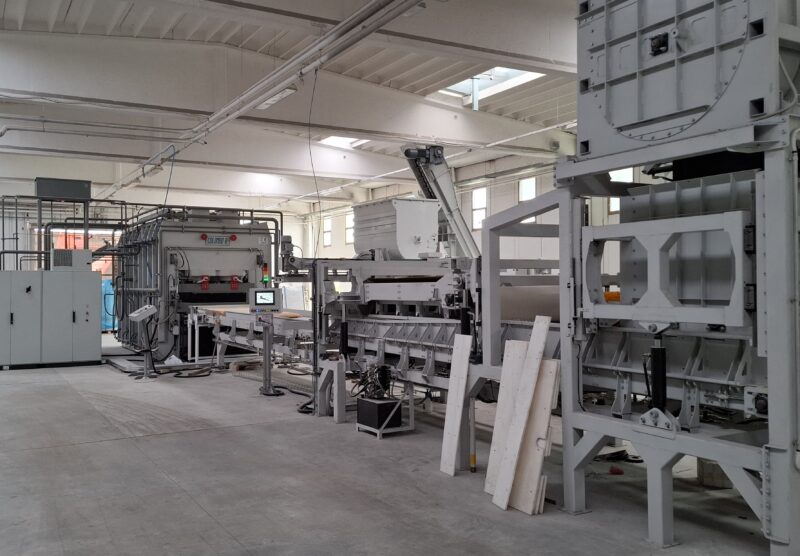
REFRESH participates in WindEnergy Hamburg as member of Wind Innovation Cluster Hub
REFRESH at WindEnergy Hamburg 2026