

 The French group Etat9 is a major actor in environmental services, including decontamination and waste management. As part of the REFRESH project, the company will design and prototype optimised equipment for cutting large wind turbine blades.
For more than 20 years Etat9 has been supporting its customers in crisis situations or situations involving technical or environmental challenges that threaten the sustainability of the company, the health and the integrity of the environment. Founded by experts in decontamination and emergency intervention, Etat9 offers customised solutions for any project related to environmental risks.
Headquartered in Gonesse, Paris area, Etat9 can operate on the whole French territory and internationally in all the fields relating to the rehabilitation of polluted sites and soils, dismantling of installations and their reconstruction. The group has developed the skills and resources to carry out complete projects, from the initial technical study to the completion of the work. Its services include: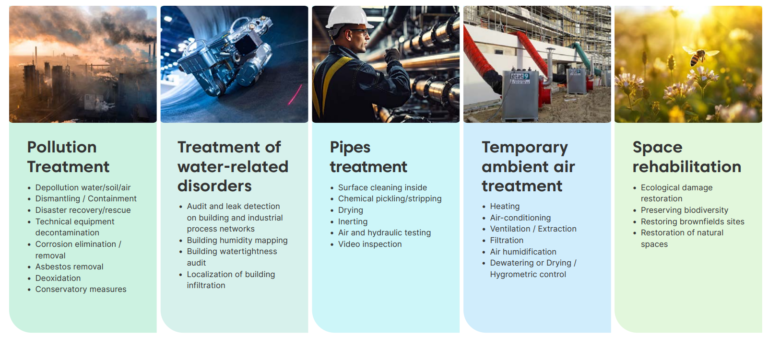
Etat9’s role in REFRESH
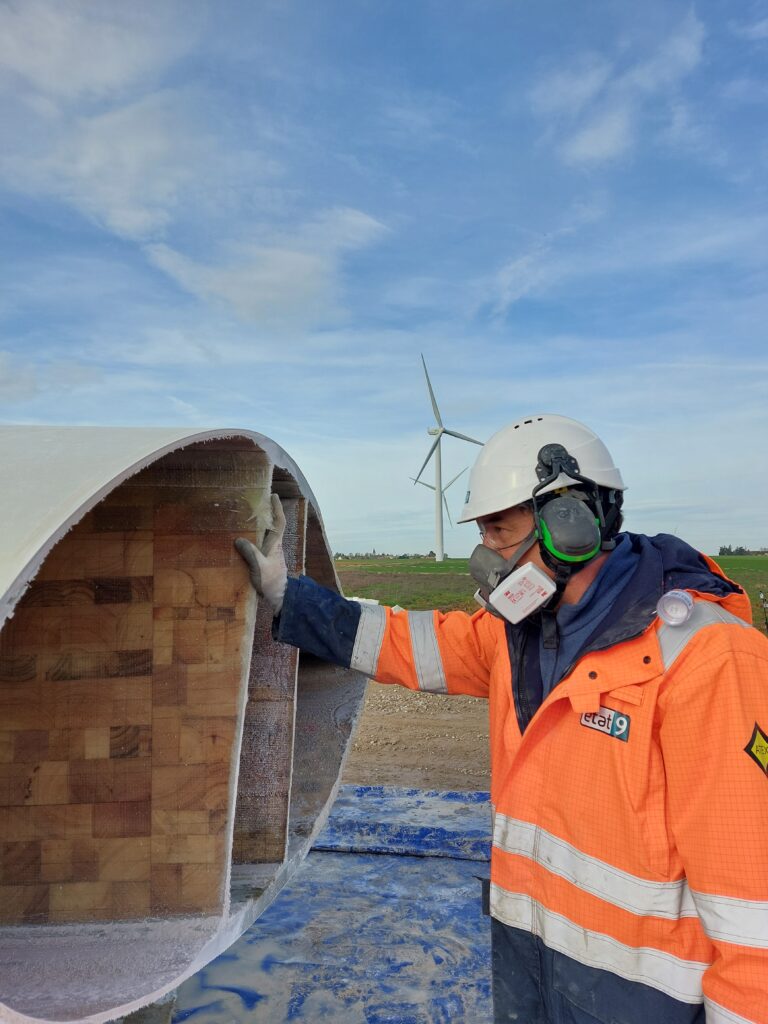 As part of Work Package 1: Design of portable dismantling, shredding and sorting technologies, Etat9 is designing an advanced processing system optimised for dismantling wind turbine blades.
This task will be realised by evaluating and selecting an enhanced saw system and dust control solution for the initial cutting of large blades. The design phase will consider one or more solutions, suitable to manage different size blades, but with a specific target of efficiency for the range of 50-80 m long blades.
The technology review will mainly consider the water-based dust control, inherent water management and treatment, the technological study of available industrial machines (type of saws) and the association of selected technologies, multi-criteria analysis based on selected characteristics of blades and ways to valorise the material. The objectives are the evaluation and selection after onsite experiences according to environmental, work safety and economic efficiency, as a key result for the project’s go/no-go decision. A cost analysis will be made on the final selection, as an input for the business plan work package.
The cut blades are being supplied to MTB for further downsizing and materials sorting. The resulting materials are then transferred to Gees Recycling, Gjenkraft and CIRCE for testing in their recycling and recovery processes.
We asked Jean-Baptiste Strehaiano, Chargé d’Affaires éolien, about Etat9’s work in the REFRESH project.
What is Etat9’s experience in the wind energy sector?
Etat9 has dismantled blades that fell to the ground in Patay (France). Several times, we have repaired some cubicles of wind turbines in the south of France. In other works, we have decontaminated the area around a burnt wind turbine to avoid soil contamination of agricultural fields.
What attracted Etat9 to join the REFRESH project?
Etat9 is engaged in the environment fields through its activities in pollution treatment and space rehabilitation. In order to increase the scope of activities, and because we’ve already worked in the wind turbine field, Etat9 wants to develop its activities in wind turbine dismantling, and more precisely in wind turbine blade recycling.
What are the main challenges in dismantling, cutting and transporting blades?
Blade cutting is a delicate work because it’s involved in environment challenges due to dust and energy consumption. Wind farms are located in agricultural regions or sensitive natural areas such as forests and mountainous regions. These areas are often home to wildlife ecosystems on the one hand, and crops on the other. It is therefore one of our objectives to keep wind farm areas clean during dismantling operations.
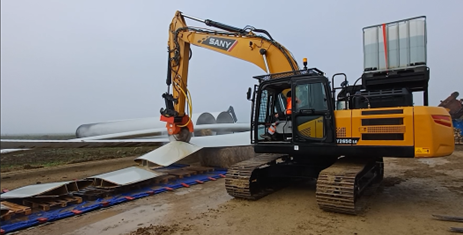
25t excavator cutting blade tip in 2 m long parts.
Nowadays, working conditions and respect for workers’ health are priority criteria to be considered when designing operating methods. Outdoor operations for the cutting of imposing (more than 40 m long) and heavy (more than 8 tons) blades require substantial equipment. As a result, we have considered the safety and healthcare of workers in the design of the cutting methods.
In order to promote the principles of the circular economy in the end-of-life of wind turbine blades, it is necessary to define the material recovery routes before dismantling to allow for adequate and optimal cutting. The financial profitability of ‘custom’ cutting depends on the maturity of the treatment channels in reuse, recycling or thermal recovery.
In another way, we’ll decrease energy consumption and thus the carbon footprint of our sites despite the use of heavy machinery necessary for operations on large-scale elements.
What do you hope to have achieved by the end of the project?
The outcome of the project will make it possible to define a specific cutting method that meets the requirements of the recovery circuits in order to obtain a high environmental quality according to the 3Rs concept. The 3Rs means REDUCE, REUSE and RECYCLE. These actions aim to minimise the environmental impact by reducing the waste quantity generated, reusing the objects as much as we can and recycling materials to reuse them in another way.
- REDUCE: This part of the 3Rs rule is not part of the REFRESH project.
- REUSE: We can reuse the wind turbine blades in several ways. First, for some, we can recondition them to be reused on other wind turbines. Otherwise, we can rework some parts of the blades to make street furniture such as billboards, benches, children’s playgrounds or bicycle parking.
- RECYCLE: Blades need to be cut precisely, using a versatile method that adapts to all types and sizes of wind turbine blades, to enable efficient shredding and sorting afterwards. This operation will enable efficient separation of the materials so that they can be thermally recovered to create secondary raw materials for cement or new composites.
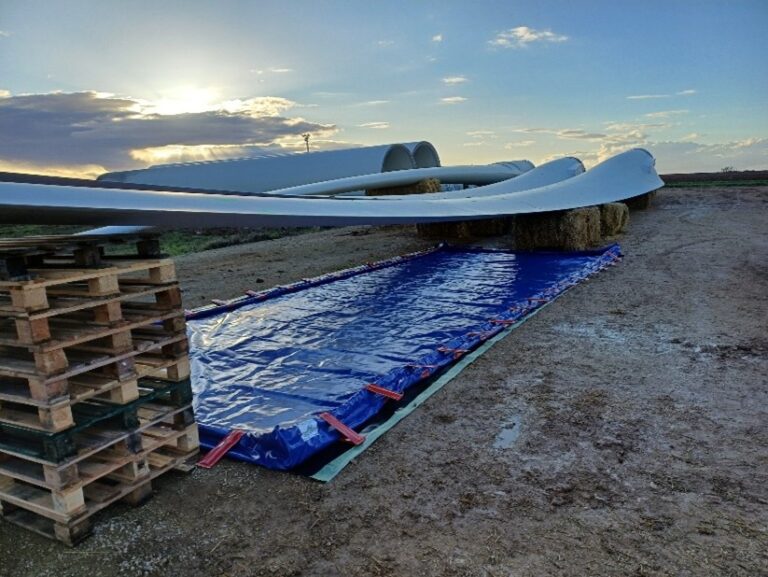
Blades ready to be cut on wind farm site.
Following the 3Rs rule in the REFRESH project will make wind energy even more sustainable by reducing its environmental impact and creating a circular economy that adds value to the resources used.
At the end of the project, and after, we want to reach an economic model sustainable with an integrated activity to our corporation’s development.
Read about our other partners:
- ACCIONA
- CETMA
- CIRCE
- Enecolab
- EuCIA
- Gees Recycling
- Gjenkraft
- MTB Manufacturing
- RINA Consulting
- TECNALIA
REFRESH participates in WindEnergy Hamburg as member of Wind Innovation Cluster Hub
REFRESH at WindEnergy Hamburg 2026