

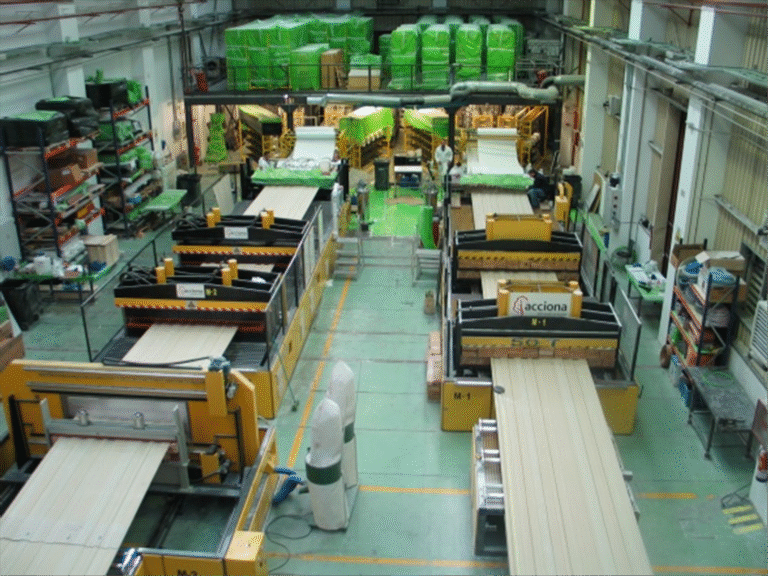
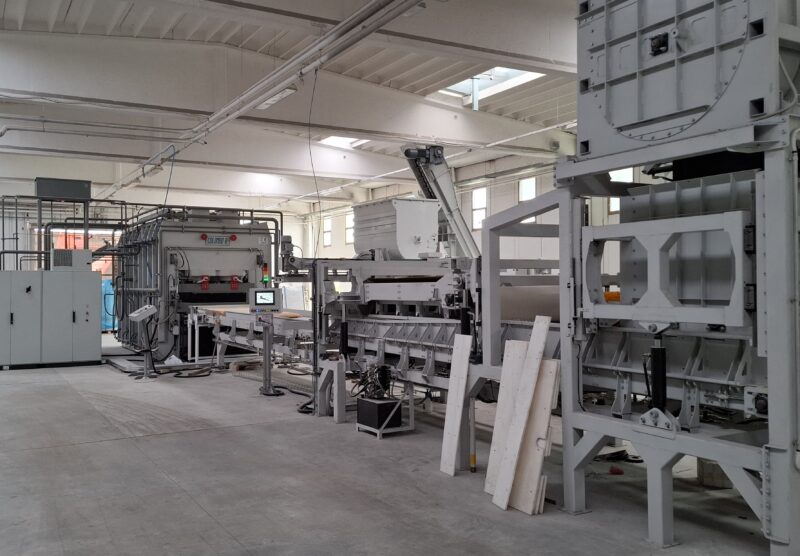
Pultrusion lines at ACCIONA’s R&D Centre. (Image © Acciona.)
In the REFRESH project, ACCIONA Construccion SA is exploring ways of integrating recycled wind blade materials into products for the construction sector.
ACCIONA Construction is a large construction company specialised in construction, engineering, and concessions (transport and hospitals). It is actively involved in far-reaching R&D and innovation aimed at reducing the environmental impact of its activities and taking care of the surroundings wherever it operates. ACCIONA uses cutting-edge technology to develop and apply the most advanced materials, components, systems and solutions for sustainability and in particular for energy efficient concepts, design, construction and operation.
ACCIONA has its own R&D Technological Centre in Madrid, composed of a multidisciplinary and international team of 100 highly qualified researchers from a wide range of disciplines. The main research areas are Nanotechnology, New Construction Materials, Products and Systems, ICTs, Energy Efficiency and Environmental Technologies.
ACCIONA’s role in REFRESH
In REFRESH, ACCIONA is responsible for infrastructure prototype developments to validate the performance of the new end products developed within the project, and to turn them into new useful composites in construction applications.
We spoke to Eva Martínez Barrigüete, Group Leader of Polymers and Composites, R&D Technology Centre, and Anurag Bansal, Head of Strategic Innovations, Technology and Innovation Division.
How does the REFRESH project align with ACCIONA’s innovation activities?
The aim of the REFRESH project is to develop and demonstrate a novel circular, smart system for recycling end-of-life wind blades and to use the recycled composite materials to produce a wide range of re-manufactured products. These will be implemented in several applications in a variety of sectors, among them, the construction sector in which ACCIONA specialises in developing regenerative infrastructure offering comprehensive solutions in manufacturing both recycled and non-recycled composite materials.

Demo 1: profile.
What recycled materials will you be using in the REFRESH prototyping developments? What prototypes will you develop?
ACCIONA will manufacture three prototypes (Demo 1, 2 and 3) using materials recycled from wind blades.

Demo 2: laminate.
Demo 1 consists of a flat pultruded profile using composite powder which will be obtained from the structural parts of the wind blade. The powdered material will be mixed with resin and the profile will be manufactured using the pultrusion process.
Demo 2 will include nonwoven mats manufactured with thermally recycled glass fibre. A thermoset composite in the form of a laminate will be manufactured by infusion of the nonwoven mat with epoxy or vinyl ester resin.
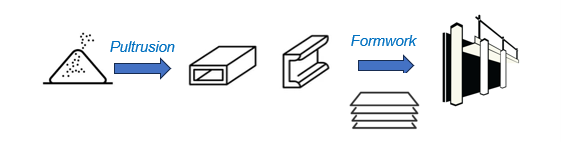
Demo 3: formwork for concrete.
Demo 3 will be a formwork for concrete structures. The sheathing panel will be made with materials from wind blade residue, whereas the studs will be made with pultruded profiles manufactured similarly to Demo 1.
These three demo cases represent examples of integration of recycled materials in the construction sector.
What challenges do you face in trying to incorporate recycled blade materials into new construction and infrastructure products?
While composites are the primary material used in wind turbine blades, they are not commonly used in the construction industry in structural applications, although these materials are quite common in thermal and acoustic isolation. Nowadays, integrating composites into the construction sector poses significant challenges due to lack of design knowledge, installation training, standardisation, raw materials cost and availability in comparison with concrete and metals.
Regarding recycled composite materials, the main challenge is finding a stable supply chain that guarantees the material supply for a whole project. Moreover, market acceptance is hindering the introduction of these kinds of materials on the construction sector, a very traditional sector in which introducing new materials and construction techniques requires longer times than other sectors. Thus, adapting these recycled materials is crucial.
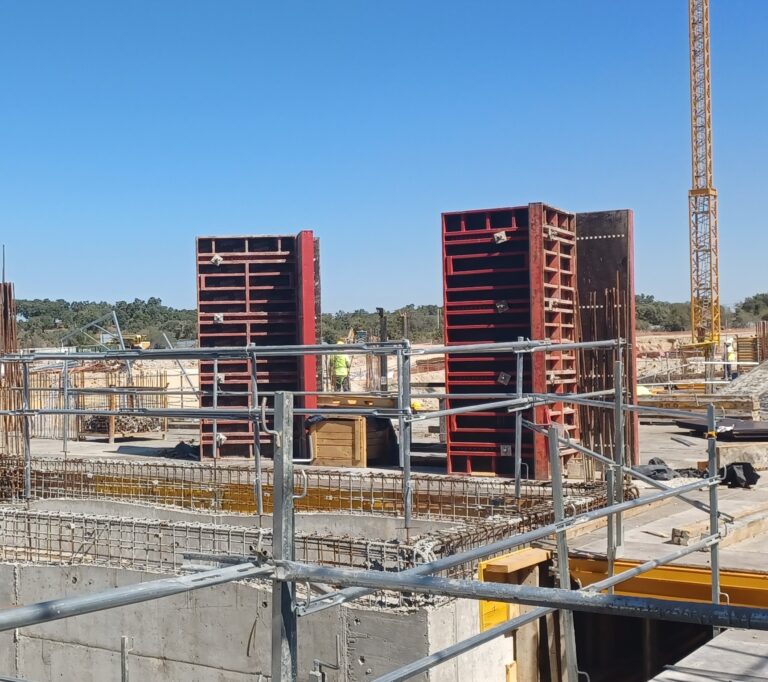
Formwork for concrete is one potential application for recycled blade materials. (Image © Acciona.)
Another challenge is that the mechanical properties of the recycled materials do not often match those of the composite of origin. The recycling process frequently requires a size reduction of the fibres, which implies a drop in the mechanical properties of the recovered material. This makes it difficult to use it in the same application. Nonetheless, several recycling methods are being explored and optimised within the REFRESH project, trying to broaden the range of materials recycled from wind blades.
Despite these challenges, the industry is working towards introducing recycled composites in new construction projects. In some countries (such as Northern Europe countries, Canada and Australia) new initiatives are emerging, for example, the introduction of more sustainable materials (such as recycled composite materials) is promoted and valued in a positive way in the selection of tenders. These efforts will boost the implementation of recycled composite materials in the construction sector, reducing the carbon footprint and making this industry more sustainable.
What do you hope to have achieved by the end of the project?
ACCIONA aims to develop expertise in the use of recycled materials, building on its extensive experience in the construction sector.
While introducing recycled composite materials as substitutes for new ones presents challenges, it is a crucial step towards a more sustainable industry. To support this transition, ACCIONA will actively assist all technical partners in upgrading their technologies and integrating them into its business, contributing to the creation of a new circular/green category within existing portfolios.
These solutions reflect a growing market demand. Although they are not expected to generate significant additional economical turnover in the short term, the environmental and social benefits in the long term will be considerable.
For further information visit the ACCIONA website.
Read about our other partners in these articles:
REFRESH participates in WindEnergy Hamburg as member of Wind Innovation Cluster Hub
REFRESH at WindEnergy Hamburg 2026