

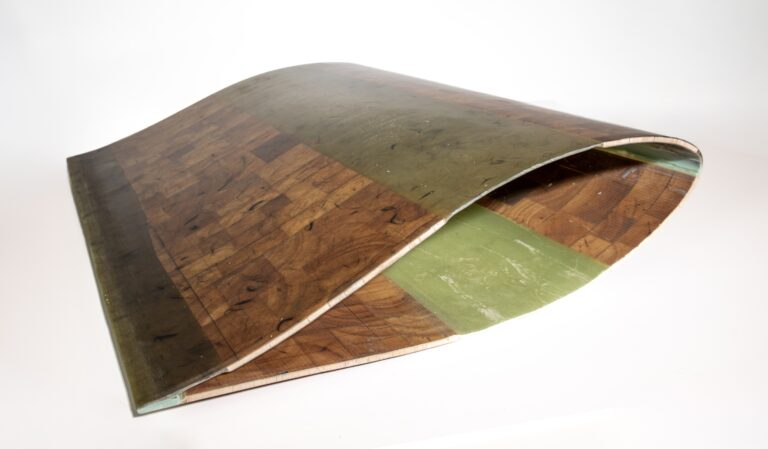
The composite skins of the upper shell of this 1.0 m x 1.5 m blade section were manufactured using recycled glass fibre. (Picture © CETMA / ÉireComposites.)
The EU-funded REFRESH project has achieved a notable advance in circularity for the wind energy sector by demonstrating that recycled glass fibres from decommissioned wind turbine blades can be used in the manufacture of a new blade.
In this study, REFRESH partners CETMA (Italy) and Gjenkraft AS (Norway) collaborated with Cormatex (Italy) and ÉireComposites (Ireland) to convert glass fibres recovered through Gjenkraft’s thermal recycling process into a nonwoven mat which was then employed in a non-structural application of a section of new blade.
“This is one of the few recent examples of a wind turbine blade section that has been manufactured using recycled materials recovered from end-of-life wind turbine blades,” reports Andrea Tinti of CETMA. “This result clearly highlights the strength of collaboration within the REFRESH consortium and the successful construction of a new circular value chain, bringing together partners with complementary expertise from different industrial sectors.”
“This is tangible proof that full circularity for wind energy is possible,” says Marcin Rusin, CEO of Gjenkraft AS. “We have now moved from laboratory testing to a real component that demonstrates how recycled fibres can be used in new blades. It demonstrates the power of European collaboration – where technology, innovation and sustainability truly come together.”
REFRESH: advancing blade circularity
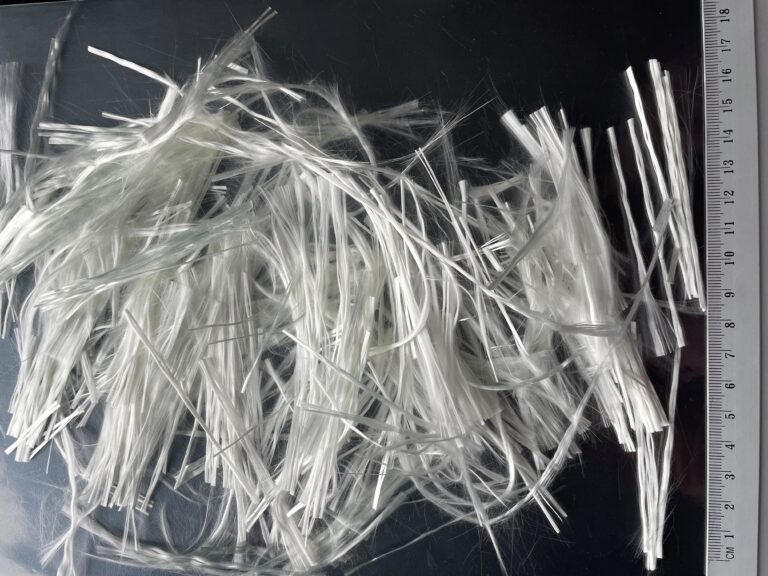
Recycled fibres recovered using Gjenkraft’s thermal recycling process. (Picture © Gjenkraft AS.)
As many European wind farms approach the end of their projected operational lifetimes, the European wind industry is intensifying its circularity efforts. Sustainable strategies for managing the growing volumes of decommissioned blades – manufactured from durable, challenging-to-recycle composite materials – is critical.
The REFRESH project is building a smart, circular value chain to improve the recycling of glass fibre reinforced composites from decommissioned blades. Now entering its fourth year, REFRESH is currently scaling up the recycling processes developed in the project’s initial phase and focusing on the design of products utilising the recovered materials. Led by research and technology centre CETMA, this design work includes demonstrating viable applications for the recycled glass fibres obtained from Gjenkraft’s advanced thermal recycling process. One promising approach under investigation is the reprocessing of recycled fibres into nonwoven mats.
Textile machinery manufacturer Cormatex’s airlay/thermobonding technology was used to manufacture the nonwoven mat. Unlike mechanical needlepunching, where repeated needling causes the fibres to interlock and entangle, thermobonding relies on the adhesive effect of a thermoplastic binder. This can be beneficial when working with thermally recycled fibres which may become brittle after exposure to high temperatures. Airlay/thermobonding is a continuous process and allows the production of mats with recycled fibre content of up to 90-95% by weight.
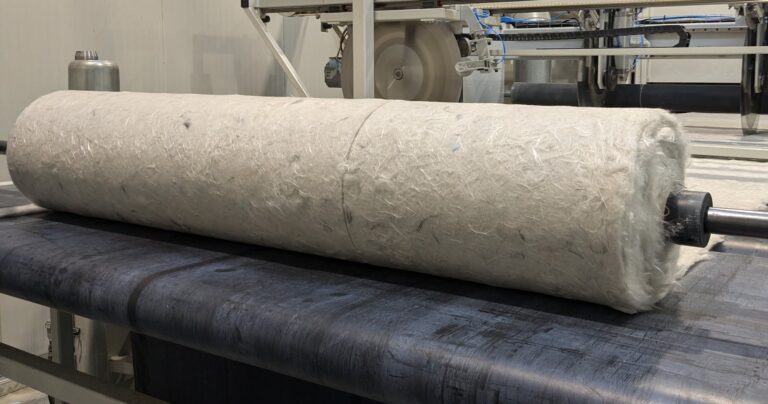
Production of the recycled glass fibre nonwoven mat. (Picture © Cormatex.)
CETMA evaluated the mat’s compatibility with the vacuum infusion process, which is widely used to manufacture composite parts for wind energy and other markets. Tests revealed that composite laminates manufactured using the recycled glass fibre mat exhibited mechanical properties close to those of laminates manufactured using commercial virgin glass fibre mats with similar characteristics.
Luca Querci, Managing Director, Cormatex: “We are excited to see this excellent result of the REFRESH project. This is the confirmation that our innovative Airlay technology “Lap formair H” is perfectly suitable for processing special fibres such as glass fibre and carbon fibre and that it can fruitfully contribute to recycling processes of glass fibre or carbon fibre composite materials. We look forward to the new market opportunities that this outstanding result is developing for our special technology!”
Closing the loop
The recycled glass fibre mat has a range of potential applications but returning it to the wind energy sector as an alternative to virgin materials is the optimal solution. Its suitability for use in a non-structural element of a blade was therefore evaluated in collaboration with ÉireComposites.
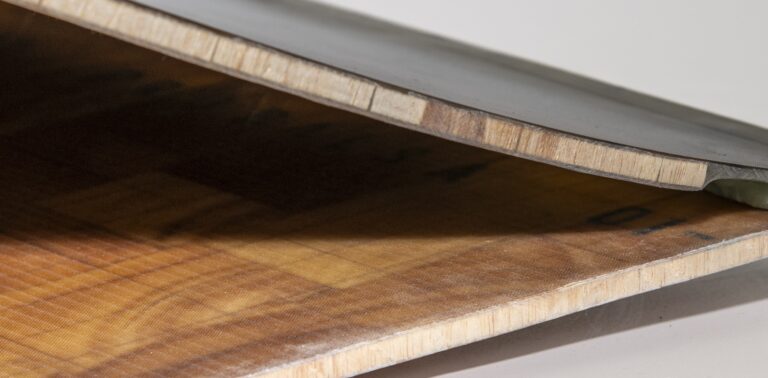
Blade section structure, showing upper shell with recycled glass fibre laminates and balsa core material.
(Picture © CETMA / ÉireComposites.)
A 13 m long blade was selected for this study. The composite skins of both halves of the blade are currently manufactured using virgin triaxial glass fibre reinforcement which could potentially be replaced by the recycled glass fibre mat. To confirm this, ÉireComposites manufactured a section of the blade tip, approximately 1.0 m x 1.5 m in size, by vacuum infusion. The top and bottom shells were produced separately and bonded at the leading edge and trailing edge: one employed triaxial glass fibre in the inner and outer skins, while the other used the recycled glass fibre mat. This approach allowed a direct comparison of the virgin and recycled materials in the same part.
Conor Kelly, Engineering Manager, ÉireComposites: “We are impressed by the quality and finish of the skin section reinforced with the recycled glass fibre mat. This shows great potential to replace virgin glass fibre in non-structural wind blade components and is a step closer to making circular blades a reality.”
Next steps
This prototype blade section demonstrates the feasibility of incorporating recycled glass fibre into new blades without altering the manufacturing process. Further experimental validation is now in progress at CETMA to evaluate the mechanical performance of the part.
CETMA is also developing applications for the secondary raw materials resulting from the REFRESH mechanical recycling process with Gees Recycling, and exploring the use of recycled glass fibre in 3D printed concrete structures together with TECNALIA. In addition, CETMA and ETAT9 are collaborating on the REFRESH repurposing strategy, designing new products from precisely cut blade parts. Life cycle assessment and life cycle costing analyses conducted by RINA Consulting will ensure the sustainability of all the REFRESH solutions, while a blockchain traceability platform will enable tracking of blade components and materials through the value chain.
By scaling up solutions to transform end-of-life blades into valuable resources and products, REFRESH aims to showcase the viability of making blade recycling an integral part of the circular wind economy.
Download the press release.
Watch videos of infusion tests on the nonwoven mat on YouTube.
About REFRESH
REFRESH (Smart dismantling, sorting and REcycling of glass Fibre REinforced composite from wind power Sector through Holistic approach) is a European project aiming to develop and demonstrate a novel circular, smart system enabling improved recycling of glass fibre reinforced composites derived from wind turbine dismantling or reblading.
The 11 REFRESH partners are project coordinator RINA Consulting (Italy), ACCIONA Construccion (Spain), CETMA (Italy), CIRCE (Spain), Enecolab Srl (Italy), ETAT9 (France), EuCIA (Belgium), Gees Recycling (Italy), Gjenkraft AS (Norway), MTB (France), and TECNALIA (Spain).
The four-year project ends on 31st December 2026.
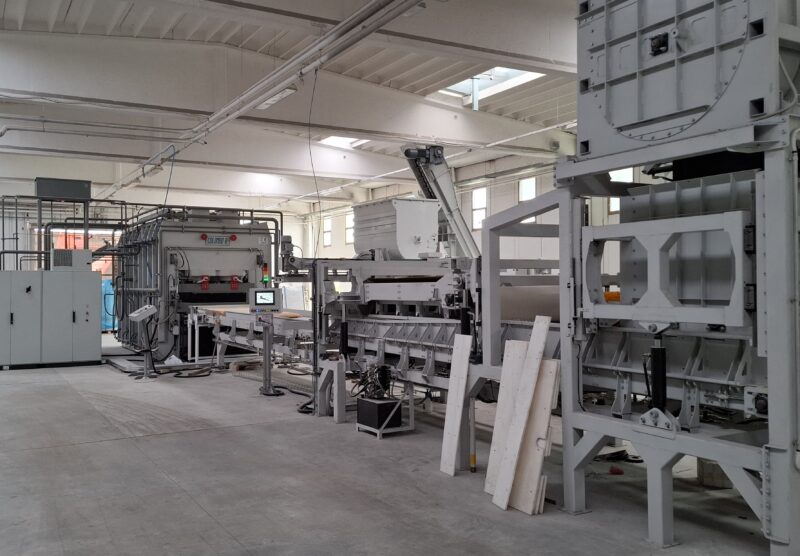
REFRESH participates in WindEnergy Hamburg as member of Wind Innovation Cluster Hub
REFRESH at WindEnergy Hamburg 2026